Table of Contents
Marketing decisions are easier when they start with evidence instead of assumptions. Market research helps marketers understand customers, competitors, demand, pricing, behavior, and changes in the market before deciding what to do next. The challenge is not simply finding more information. It is knowing which questions to ask, where to look, how to interpret the data, and how to turn what you learn into action. In this guide, we’ll walk through a practical way to do market research—from defining the marketing question to gathering evidence, finding patterns, testing an insight, and measuring what happens afterward.
Quick answer: To do market research, start with a specific marketing decision, identify the information needed to make it, collect evidence from relevant customer, market, and competitor sources, analyze recurring patterns, and turn the findings into a testable marketing action. Good research is not about collecting the most data. It is about collecting the right evidence for the decision in front of you.
What Is Market Research Really Used For?
Market research is often presented as a process for collecting information about a market.
That is true, but it misses the part marketers actually care about.
The purpose of research is to reduce uncertainty around a marketing decision.
For example, a company might want to know:
- Who is most likely to need its product?
- What problem matters most to potential customers?
- How do customers describe that problem?
- What alternatives are they already using?
- What do customers like or dislike about competitors?
- Is demand strong enough to support a new offer?
- Which market segment should receive more attention?
- What message should the company test?
- Where are competitors leaving customer needs unresolved?
The U.S. Small Business Administration recommends examining factors such as demand, market size, location, market saturation, pricing, demographics, and economic conditions when researching a market. It also recommends combining market research with competitive analysis to understand businesses competing for the same customers.
That distinction matters because data is not the same as insight.
Suppose you collect 5,000 customer reviews.
The dataset itself is not the insight.
The insight might be that customers repeatedly mention slow response times, confusing onboarding, or a feature they wish existed.
That observation can then lead to a marketing question:
Could faster onboarding become a meaningful part of our positioning?
Now the research has somewhere to go.
Data tells you what you observed. Insight helps you understand what it could mean. Strategy determines what you do next.
Start With a Marketing Question, Not a Data Source
One of the easiest ways to waste time on research is to start with a tool.
You find a scraper, database, analytics platform, survey tool, or AI application and then ask:
“What can I collect?”
A better question is:
“What decision am I trying to make?”
That change sounds small, but it affects the entire research process.
If an agency wants to expand into a new industry, for example, the research question might be:
Which types of businesses have a strong need for our service and enough evidence of that need to justify targeting them?
That question tells you what information matters.
You may need to examine:
- company type
- location
- number of locations
- existing marketing activity
- customer complaints
- competitor presence
- pricing
- demand signals
- decision-maker roles
You do not necessarily need every piece of information available.
Match the Research to the Decision
| Marketing decision | Useful research question |
|---|---|
| Targeting | Which customers have the strongest need? |
| Positioning | What alternatives are customers comparing? |
| Messaging | What problems and outcomes matter to customers? |
| Product development | What unmet needs appear repeatedly? |
| Lead generation | Which businesses fit our target profile? |
| Market expansion | Which locations or segments show potential? |
| Competitive strategy | Where are competitors strong, weak, or differentiated? |
This question-first approach also helps prevent a common problem: collecting a large dataset simply because a tool makes it possible.
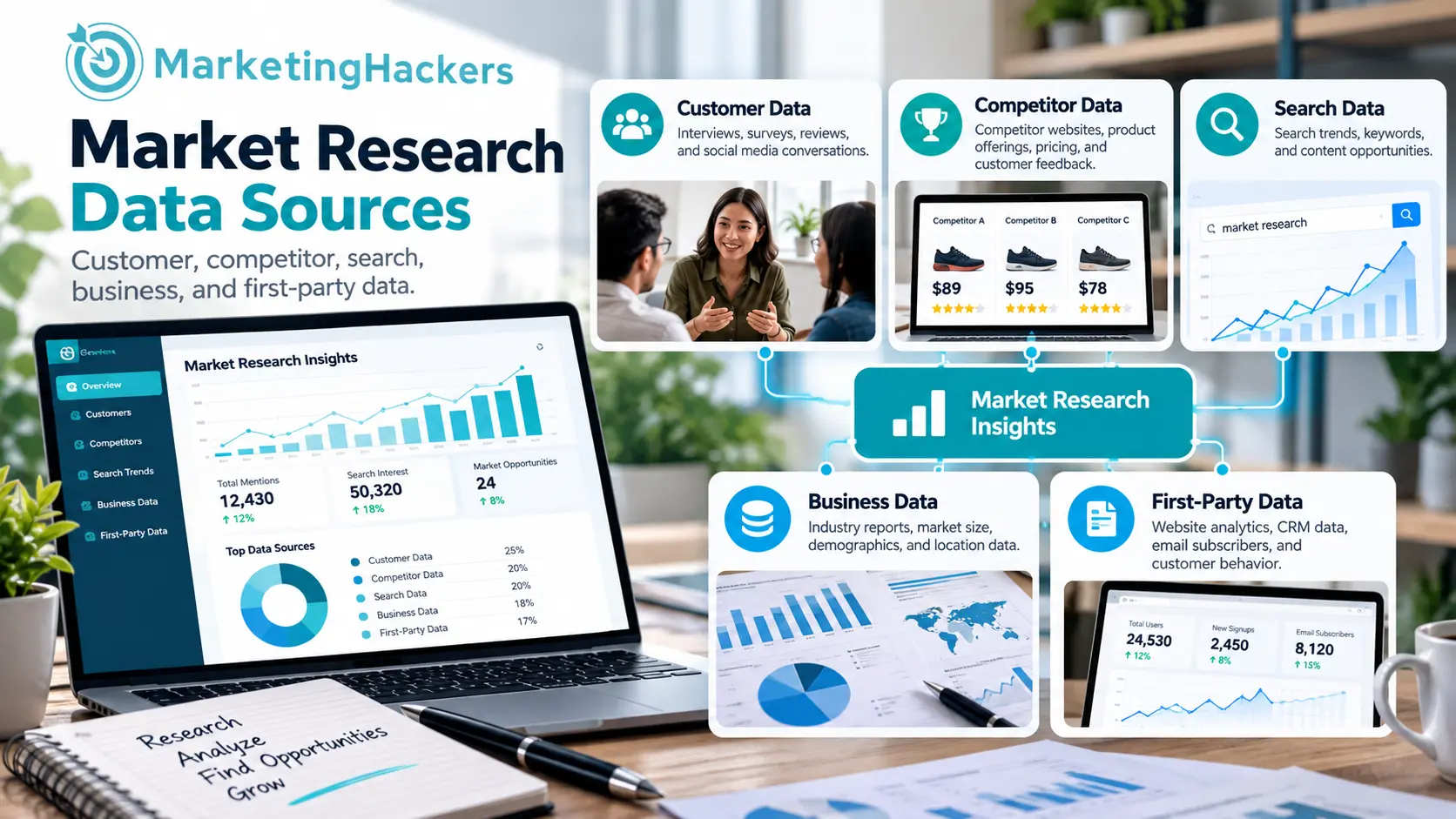
Where Marketers Can Find Customer and Market Data
There is no single source that can answer every marketing question.
Good research often combines several sources because each one reveals something different.
Customer Conversations
Customers already produce useful information through:
- reviews
- surveys
- interviews
- support conversations
- comments
- community discussions
- social posts
- sales conversations
The important part is not simply collecting comments.
Look for recurring language, questions, frustrations, expectations, and differences between customer groups.
MarketingHackers already explores how YouTube comments can be used to discover communities and understand what people are discussing. That approach can fit into a broader customer-research process. Turn YouTube Comments Into Market Research Gold
Search Behavior
Search data can help reveal what people are trying to understand or solve.
Look at:
- search queries
- related questions
- search intent
- recurring topics
- search-result patterns
- gaps in existing information
Search research can be especially useful when you are trying to understand the language customers use before they become leads.
Competitor and Market Data
Competitor research can include:
- websites
- product pages
- pricing pages
- reviews
- offers
- positioning
- content
- customer complaints
- customer praise
Broader market research can also include demographic information, industry data, pricing information, geographic information, and other public datasets.
The SBA notes that existing sources can help answer general and quantifiable questions, while direct research can provide more specific information about a business’s customers. Direct methods include surveys, questionnaires, focus groups, and in-depth interviews.
For local-market research, business listings can also help marketers understand where relevant businesses operate and what characteristics appear across a target market.
The key is to choose the source based on the question not the other way around.
That article goes deeper into extracting and analyzing review information as a source of business intelligence.
MARKET RESEARCH TIP
The best research starts with a question, not a tool. Before collecting customer or business data, define the decision you need to make. Then choose the sources that can actually help you answer it.
How to Turn Raw Data Into Customer Insights
Collecting information is only the beginning.
The next challenge is separating useful patterns from noise.
Imagine a marketer collects 1,000 reviews from several competing businesses.
A weak analysis might report:
- Competitor A: 4.6 stars
- Competitor B: 4.4 stars
- Competitor C: 4.2 stars
That describes the data.
It does not necessarily explain the market.
A stronger analysis could reveal:
- customers repeatedly praise fast responses
- several competitors receive complaints about unclear pricing
- customers mention long wait times
- certain services receive unusually positive feedback
- complaints change during particular periods
Now the marketer has something to investigate.
Use a Simple Analysis Process
1. Clean the data
Remove obvious duplicates, irrelevant records, and unusable entries.
2. Segment it
Group information by useful dimensions such as:
- customer type
- location
- product
- competitor
- date
- problem
- sentiment
- purchase stage
3. Look for repetition
Repeated signals can be useful starting points for investigation, but repetition alone does not prove why something is happening.
4. Compare groups
Do customers in one location behave differently from another?
Do high-value customers mention different problems?
Do competitor customers complain about the same issue?
5. Form a hypothesis
Do not immediately treat a pattern as proven.
Instead ask:
“What could explain this pattern?”
6. Validate it
Look for additional evidence.
This is where market research becomes more rigorous.
A single review can generate a question.
A recurring pattern across relevant observations can justify a stronger hypothesis.
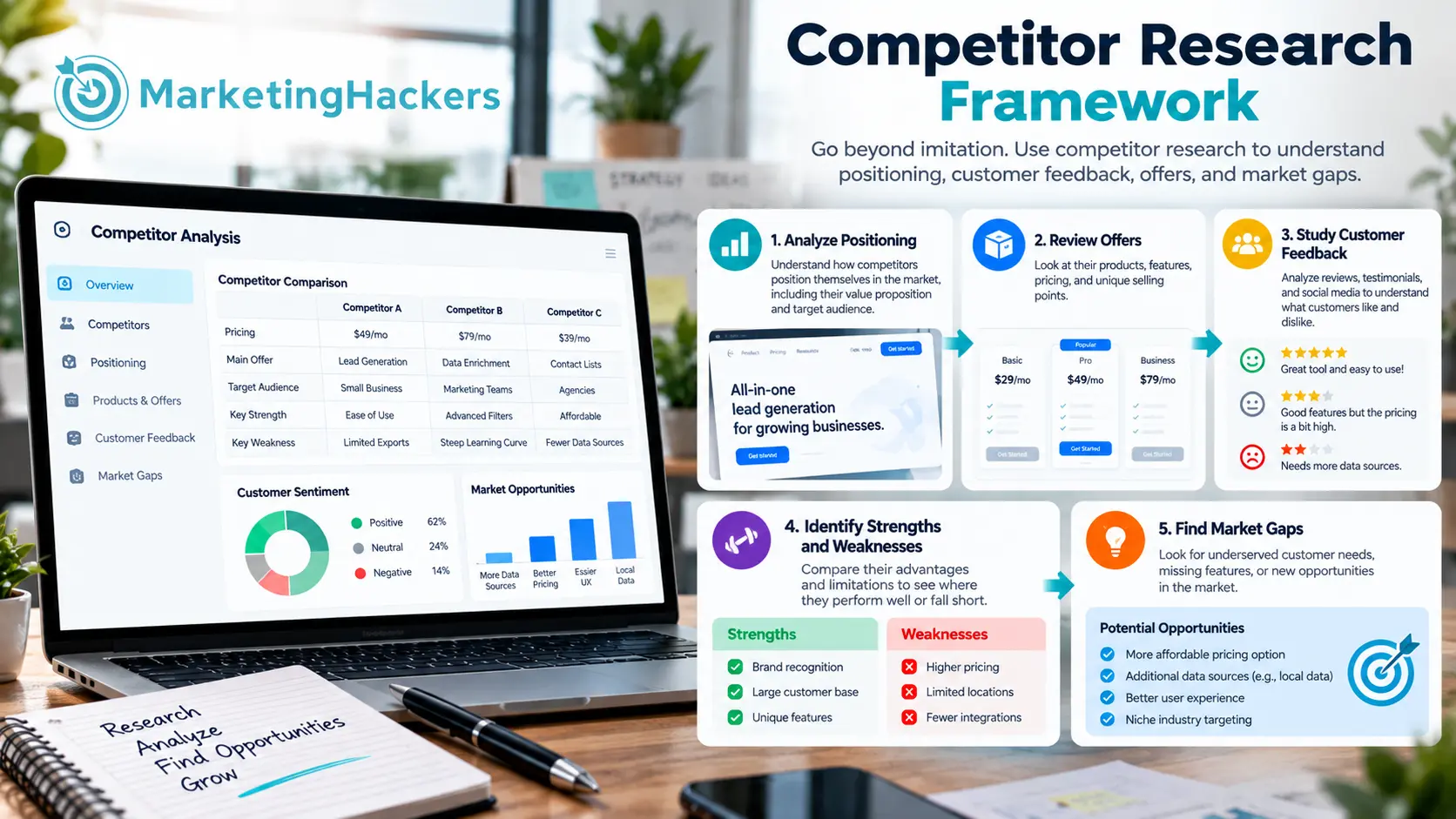
How to Analyze Competitors Without Copying Them
Competitor research is useful when it helps you understand the choices customers have.
It becomes less useful when the goal is simply to imitate another company.
Start by looking at:
What they offer → Who they target → How they position it → What customers say → Where gaps appear
The SBA recommends examining competitors’ strengths and weaknesses, market segments, barriers, market opportunity, and indirect competitors as part of competitive analysis.
What are competitors promising?
Look at:
- headlines
- value propositions
- offers
- guarantees
- product benefits
- calls to action
Who are they trying to attract?
Look for signals in:
- language
- industries served
- customer examples
- pricing
- product packaging
- case studies
What do customers actually say?
This is where competitor reviews can become more useful than competitor websites.
A company may describe itself as:
“fast, affordable, and customer-focused.”
Customers may reveal something different.
They might repeatedly mention:
- slow support
- difficult onboarding
- confusing billing
- limited customization
Those observations do not automatically mean the competitor is failing.
They give you questions worth investigating.
MarketingHackers already has a tactical article about using Trustpilot reviews for competitor analysis, so this pillar should point readers there rather than repeat the entire extraction process.
Internal resource: How to Use a Trustpilot Scraper for Competitor Analysis
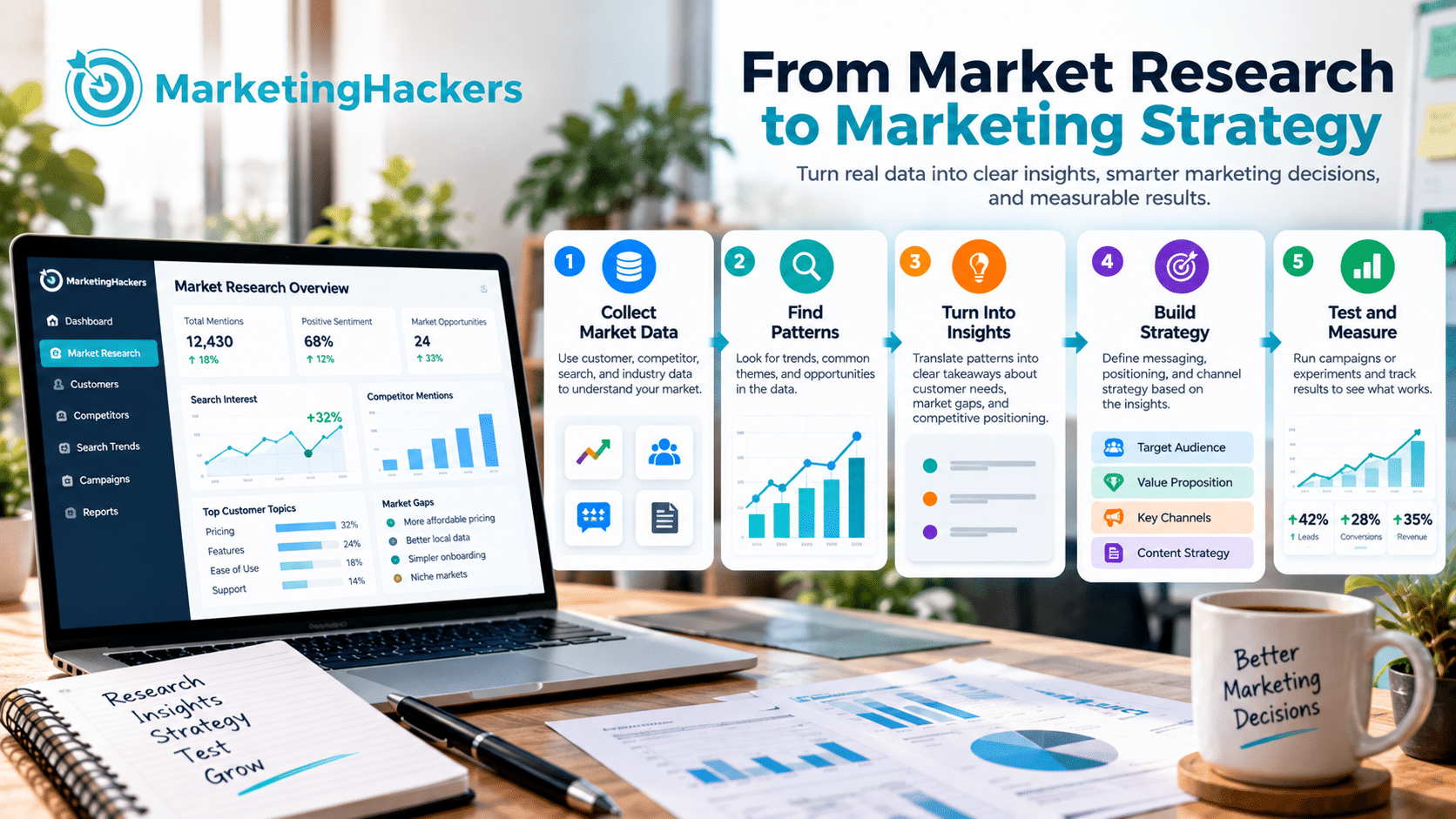
Turn Research Into a Marketing Strategy
This is the point where research earns its place in the marketing process.
A research report sitting in a folder does not change your marketing.
A decision does.
Suppose research shows that customers repeatedly complain about slow communication from service providers.
That does not automatically prove that response time is the biggest buying factor.
But it gives you a hypothesis worth testing.
Research finding
Customers frequently mention slow responses.
Possible insight
Responsiveness may be an important source of frustration in the category.
Strategic question
Could faster communication become part of our positioning?
Marketing test
Test a message focused on response time against the existing positioning.
Measurement
Track relevant outcomes such as:
- qualified inquiries
- conversion rate
- response rate
- sales conversations
- customer feedback
The important principle is:
Research should change what you do next.
A Practical Example
Imagine a marketing agency wants to attract dental practices.
Instead of immediately building a list of thousands of dental businesses, it could first ask:
Which dental practices are most likely to need our service?
The agency might research:
- location
- number of locations
- website quality
- review volume
- recent reviews
- existing advertising
- social activity
- service mix
- signs of growth
The result is not simply a list.
It is a targeting hypothesis.
For example:
“Multi-location practices with strong patient demand but weak local visibility may be a useful segment to investigate.”
That hypothesis can then guide prospecting and outreach.
TURN RESEARCH INTO PROSPECTING
Once you understand which businesses fit your target market, the next step is researching and qualifying potential prospects before outreach.
Read: B2B Prospecting: How to Find and Research Business Leads
Note for publishing: Verify the exact permalink for this article in WordPress before inserting the final hyperlink. The current MarketingHackers homepage confirms the article is live, but the exact permalink was not exposed reliably in the available page result.
A Simple Market Research Workflow for Marketers
If you want a repeatable process, use this:
1. Define the decision
Write down exactly what you need to decide.
2. Define the audience
Identify the customers, prospects, competitors, or market segment involved.
3. Gather relevant evidence
Use the sources that can actually answer the question.
4. Organize the information
Segment it into meaningful groups.
5. Find patterns
Look for recurring problems, behaviors, language, differences, and changes over time.
6. Separate evidence from assumptions
Write down what the data actually shows.
Then separately write down what you think it could mean.
7. Form an insight
Turn the strongest pattern into a useful hypothesis.
8. Choose an action
Decide what should change because of the research.
9. Test it
Run a focused marketing experiment where possible.
10. Measure the result
Look at the outcome and decide whether the original hypothesis should be kept, changed, or rejected.
This creates a useful cycle:
Research → Insight → Strategy → Experiment → Measurement → New Research
Common Market Research Mistakes Marketers Make
Collecting data without a decision
A larger dataset is not automatically more useful.
If you don’t know what decision the research will support, you may collect information that never gets used.
Treating one signal as proof
One customer comment can be interesting.
One competitor can be interesting.
One survey response can be interesting.
None should automatically be treated as a market-wide truth.
Use individual observations to generate questions. Look for supporting evidence before turning them into strategic conclusions.
Researching only competitors
Your competitors are not your customers.
Their websites tell you how they position themselves.
Their customers can tell you how that positioning is experienced.
Your own customers can tell you something else entirely.
Use all three perspectives when the decision requires it.
Using outdated information
Markets change.
Competitor offers change.
Customer expectations change.
Search behavior changes.
Research should therefore have a clear date and scope.
Letting tools define the strategy
A scraper can collect data.
An AI system can summarize it.
An analytics platform can visualize it.
A CRM can organize it.
None of those tools decides what your business should learn.
The marketing question comes first. The tool comes second.
Confusing a pattern with an explanation
Suppose customers who purchase a particular product also tend to live in a particular region.
That is a pattern.
It does not automatically tell you why.
Good research keeps asking:
What else could explain this?
That habit helps prevent marketers from turning interesting data into weak conclusions.
FAQ
Market research is the process of gathering and analyzing information about customers, markets, competitors, demand, and other factors that can inform marketing decisions.
Start with a specific marketing question or decision. Then identify the information needed, gather relevant evidence, analyze patterns, form an insight, and turn that insight into an action or test.
Common methods include surveys, interviews, questionnaires, focus groups, observation, analysis of existing market data, customer feedback, reviews, competitor research, and other forms of secondary research. The SBA identifies surveys, questionnaires, focus groups, and in-depth interviews as examples of direct research methods.
Market research looks at the broader environment around a business, including demand, competitors, market conditions, and customer groups. Customer research focuses more closely on people who use or may use a product or service, including their needs, experiences, motivations, and problems.
Yes. Research does not always require a large budget. Businesses can combine existing public information with direct customer research, such as interviews, surveys, questionnaires, and feedback analysis. The SBA notes that existing sources can be useful for broader market questions, while direct research can provide more specific information about a business’s customers.
Yes. Reviews can reveal recurring complaints, positive experiences, customer expectations, and the language customers use to describe products or services. However, reviews represent the people who chose to leave them, so they should be treated as one source of evidence rather than a complete representation of every customer.
Competitor data can help marketers understand positioning, offers, customer expectations, strengths, weaknesses, and potential gaps in the market. The objective should be to understand customer choices and identify opportunities to differentiate not simply copy another company’s strategy.
AI can help marketers organize, classify, summarize, and explore large amounts of information. The SBA also notes that AI can help businesses analyze their own data and identify common themes. However, the quality of the resulting insight still depends on the quality and relevance of the underlying data and the questions being asked. AI should support the research process rather than replace marketing judgment.
READY TO RESEARCH YOUR MARKET?
Start with one marketing decision. Define the question, gather the evidence, look for patterns, and turn what you learn into something you can test.
Keep exploring MarketingHackers for practical guides on customer research, competitor intelligence, prospecting, and marketing strategy.